



The American Association of Physicists in Medicine (AAPM) is a professional organization whose members include board-certified medical physicists who specialize in the safe and effective use of radiation in medicine. Medical physicists partner with radiologists, technologists, regulators, manufacturers, administrators and others to ensure that CT scans are performed using the minimum amount of radiation required to obtain the diagnostic information for which the CT scan was ordered, or to guide the therapeutic procedure for which the CT is used.
In 2010, the Alliance for Quality Computed Tomography Working Group was formed to provide information to CT users that enhances the quality of their CT practice. The membership includes academic and consulting medical physicists who specialize in CT imaging, representatives of each of the major CT scanner manufacturers, and liaisons to the American College of Radiology, American Society of Radiology Technologists, and the Food and Drug Administration.
The Working Group was initially charged with the development of reference CT protocols, which are defined by the Working Group to be reasonable and appropriate protocols for specified diagnostic tasks. The published protocols provide typical clinical values for a sampling of currently available scanner models, and may not always match manufacturer-supplied reference protocols.
In addition to the development of reference protocols, the Working Group developed a lexicon to assist users in navigating the different nomenclature used by different manufacturers.
Since 2010, the Working Group has taken on a number of additional projects, including the development of recommendations and default values for CT Dose Alert and Notification Values, and the preparation of a number of teaching slide sets. Slides are available that describe the parameters on a CT scanner that affect the delivered dose; these include manufacturer-specific slide sets that show images of each manufacturer’s user interface. Additionally, slides have been developed that teach users about the Dose Check feature, and how to avoid potential problems that may occur in long interventional examinations.
To better represent the scope of the activities of the Working Group, which is dedicated to promoting the highest level of quality in CT imaging, we have adopted a new name: The Alliance for Quality Computed Tomography (AQCT).
It is our hope that you find the resources provided here to be helpful in achieving the highest level of quality in your CT practice.
On June 10, 2013, the Director of the Center for Devices and Radiological Health (CDRH) of the Federal Drug Administration (FDA), Jeffrey Shuren, M.D., J.D., awarded the AAPM Working Group on Standardization of CT Nomenclature and Protocols the CDRH Director’s Special Citation Award. This award was presented “For developing CT imaging radiation safety instructional materials through a collaboration of end-users, CT manufacturers, and the Food and Drug Administration.”
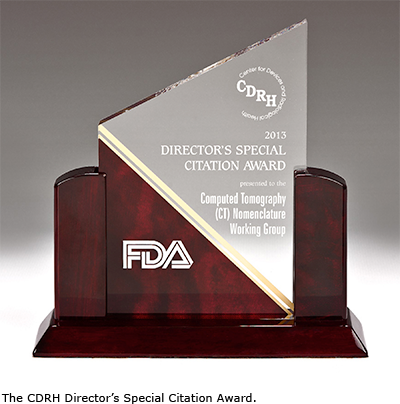 The FDA award stated:
In 2010, FDA released an "Initiative to Reduce Unnecessary Radiation Exposure from Medical Imaging", which targets high dose imaging modalities, including CT. A key partner in following through on the goals of this Initiative has been the American Association of Physicists in Medicine (AAPM) Working Group on Standardization of CT Nomenclature and Protocols. Meeting bi-weekly since 2010, the group has worked tirelessly to advance CT radiation safety through publication of publicly available resources on the AAPM website (http://www.aapm.org/pubs/CTProtocols/).
The effect of these efforts has been to improve public health by optimizing the dose of ionizing radiation during CT scans and by helping to eliminate accidental radiation overdoses during CT scanning.
The group is an outstanding example of what can be accomplished through collaboration of key stakeholders. The group includes medical physicists, radiologists, radiologic technologists, industry representatives, and regulators, from AAPM, the American College of Radiology (ACR), the American Society of Radiologic Technologists (ASRT), the Society for Pediatric Radiology (SPR), the Image Gently Alliance, the Medical Imaging and Technology Alliance, from all 7 U.S. CT manufacturers, and from the FDA.
Users with questions specific to a certain manufacturer or scanner model should contact the applications support line for that product. AAPM cannot respond to requests for specific customer support.
How to reach Applications Support for:
GE Healthcare:
- GE TiP Answerline - CT: 800-682-5327, option 1, option 3
- Email GE Support
Hitachi:
- CT Help Desk: 877-228-2777
NeuroLogica Corporation:
- 1-888-564-8561
- support@neurologica.com
Neusoft:
- 281-453 1205
- Website
Philips Healthcare:
- Customer Care Solutions Center: 800-722-9377
- Support Website
Siemens Healthcare:
- UPTIME Applications Support: 800-888-7436 (Option 3)
- Website
Toshiba Medical Systems:
Users experiencing problems in performing an exam, or that have questions on the operation or performance of their systems, should contact their service provider. The AAPM cannot respond to requests for specific customer support.
How to reach Technical Support for:
GE Healthcare:
- GE TiP Answerline - CT: 800-682-5327, option 1, option 3
- Email GE Support
Hitachi:
- CT Help Desk: 877-228-2777
NeuroLogica Corporation:
- 1-888-564-8561
- support@neurologica.com
Neusoft:
- 281-453 1205
- Website
Philips Healthcare:
- Customer Care Solutions Center: 800-722-9377
- Support Website
Siemens Healthcare:
- UPTIME Technical Support: 800-888-7436 (Option 2)
Toshiba Medical Systems:
Diagnostic medical physicists play an essential role in the delivery of high quality and safe CT examinations. For example, accreditation by the American College of Radiology in CT imaging requires the services of a qualified medical physicist, stating that the qualified medical physicist:
A primary motivation of this working group is to support and equip AAPM members in the performance of these important duties. These materials are therefore being developed specifically for the medical physics community. Although many radiologists and technologists are well educated in the technical aspects of protocol development, there are some users who may have a difficult time in understanding and correctly implementing the provided information. We fundamentally believe that patients are best served when radiologists, technologists and medical physicists work together, each bringing their unique skill set and perspective to the task of protocol optimization. Radiologists and technologists desiring access to these protocols should contact the qualified medical physicist who supports their practice. Many practices have initiated protocol review teams to individually review each protocol in their practice. A qualified medical physicist is a necessary member of this team and can facilitate comparison of a site's existing protocols with those recommended here.
The QMP plays a vital role not just in accepting a new CT scanner after it has been purchased and installed, but also in identifying key equipment specifications, equipment configuration, staff and radiologist training needs, and protocol configuration. The CT Install – Physicist Perspectives document reviews how a QMP may interact with a site, vendor and staff to facilitate a smooth installation process.
This section contains documents with information about CT Dose Notification and Alert values and how they can work in clinical practice. Dose Notification and Alert Values can be configured as part of a Dose Check feature described in NEMA XR-25. These documents also contain key points to ensure successful implementation of these features. These slides are intended for educational purposes and may be distributed freely with proper acknowledgement ("Courtesy of the AAPM Working Group on CT Nomenclature and Protocols").
Your feedback regarding the content of this website is welcome. Feedback regarding this website will not be monitored daily. Users experiencing problems in performing an exam should contact their service provider.
AAPM CT Lexicon v2.0 (03/08/2022)
Updates for the 2.0 version include Dual Energy CT Terms and additional vendors.
For the CT technologist who operates multiple scanner models, perhaps from multiple manufacturers, the variability in names for important scan acquisition and reconstruction parameters can lead to confusion, reduced comfort and an increased potential for error. The intent of this CT terminology lexicon is to allow users to translate important CT acquisition and reconstruction terms between different manufacturers' systems.
This represents a first step in the terminology standardization effort undertaken by this working group. Phase 2 of our work will:
This website will be updated as the terminology standardization work progresses.
The generic descriptions or terms in the first column are intended to orient the user to the relevant concepts; they are not consensus "preferred terms." The generic descriptions are not based on any single existing or pending terminology standard; however the references in the pdf attachment were consulted in developing the generic descriptions. Future efforts of this Working Group include making recommendations for standardized terminology.
A number of individuals and groups have advocated for terminology standardization in CT, including at a March 30-31, 2010 FDA public meeting entitled "Device Improvements to Reduce Unnecessary Radiation Exposure from Medical Imaging" (transcripts available here; see p. 153-155). Participants proposed a cooperative effort among professional organizations (AAPM, ASRT, ACR, etc.), industry, FDA, and standards organizations to accomplish this task, as is now being undertaken by this Working Group.
AAPM CT Lexicon v2.0 (03/08/2022)
This section contains documents with information on how CT acquisition parameters and CT scanner features affect the radiation dose used for a given study and how the dose is reported and tracked. These slides are intended for educational purposes and may be distributed freely with proper acknowledgement (“Courtesy of the AAPM Alliance for Quality CT”).
The "General Dose Education Slides" are available as a PowerPoint or PDF file and contains vendor-independent information on CT acquisition parameters, dose modulation and reduction and dose display. The entire slide set or pieces of it may be incorporated into any educational presentation as the user sees fit.
The Power Point slides that are accessible through the following link deal with factors that affect radiation dose in CT studies. They may be used as a resource for developing presentations on this topic.
The "Vendor Dose Education Slides" are available as PDF files only and individual slides may not be modified by the user. Each slide set follows the same outline as the General Dose Education Slides but includes vendor-specific screen shots and information on vendor specific parameters and features. The vendor specific slides were generated with the assistance of the vendor and screen shots of the scanner console/interface and descriptions of the vendor specific acquisition parameters are not representative of all scanners and software versions produced by the vendor. The slides are for instructional purposes only.
This section contains documents with information on how Automatic Exposure Control functions on CT systems. These slides are intended for educational purposes and may be distributed freely with proper acknowledgement (“Courtesy of the AAPM Alliance for Quality CT”).
The "General AEC Education Slides" are available as a PowerPoint or PDF file and contains vendor-independent information on various AEC features and how they may be implemented and affect radiation dose/image quality. The entire slide set or pieces of it may be incorporated into any educational presentation as the user sees fit. They may be used as a resource for developing presentations on this topic.
The "Vendor AEC Education Slides" are available as PDF files only and individual slides may not be modified by the user. Each slide set follows the same outline as the General AEC Education Slides but includes vendor-specific screen shots and information on vendor specific parameters and features. The vendor specific slides were generated with the assistance of the vendor and screen shots of the scanner console/interface and descriptions of the vendor specific acquisition parameters are not representative of all scanners and software versions produced by the vendor. The slides are for instructional purposes only.